
10-Inch Racks Need a Defined Front Interface
10-inch racks suit installations where a 19-inch enclosure does not fit: a desk, utility closet, small studio, or residential network edge. Their equipment may be compact, but routers, switches, patch panels, shelves, mini PCs, and power supplies still need predictable mounting, service access, and room to expand.
Is There a 10-Inch Rack Standard?
The term "10-inch rack" - also commonly written as "10in rack," "10inch rack," or "10″ rack" - does not describe one shared mechanical interface. Products with that label can use different rail mounting-hole centre-to-centre spacings, clear openings, mounting-hole types, and enclosure assumptions. An accessory that fits one rack can therefore fail to fit another.
10RIS (10-inch Rack Interface Specification) begins by giving that interface a shared definition.
Where the Dimensions Broke Down
Nodeqore came to this problem as both a user and a manufacturer. We bought a patch panel that could not be installed in a rack we printed from a community design because its mounting holes did not align. In one PDU support case, the customer reported that the unit would not mount in his rack. Review photos showed the source of the mismatch: our PDU follows the common 10-inch equipment convention, with a 10-inch maximum front-panel width including its rack ears. That user's rack used “10-inch” for the rail mounting-hole centre-to-centre spacing.
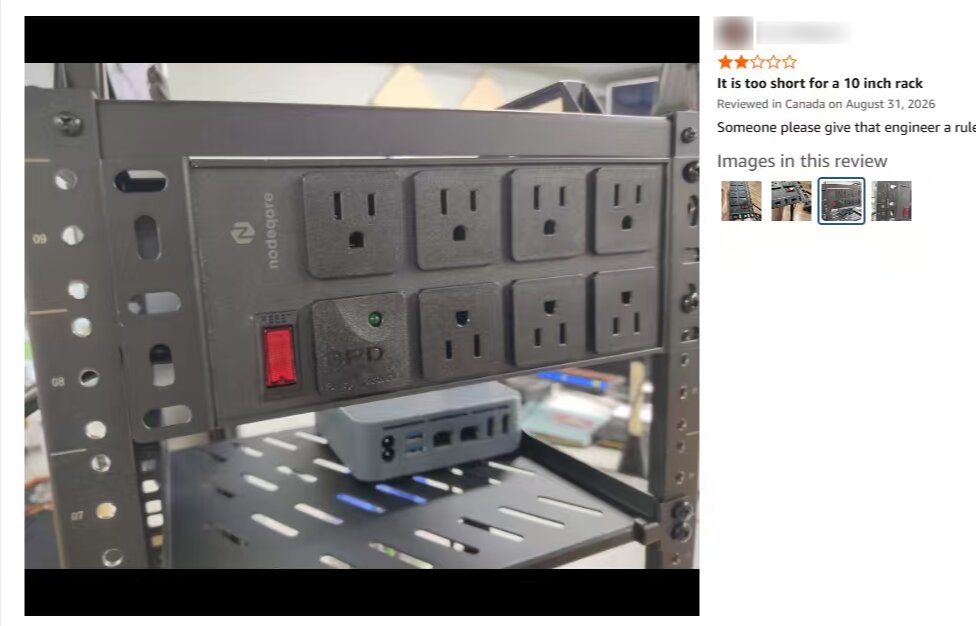
That rail placement is incompatible with the common convention used by 10-inch accessories, including our PDU, where 10 inches describes the maximum outer width of the front panel and rack ears. The fit failure came from the rack's mounting geometry, not from the PDU exceeding that equipment envelope.
That rack may work with products designed around its own geometry, especially matching equipment from the same manufacturer. However, its “10-inch” label does not specify which dimension it refers to, where it was measured, or which mounting-hole type applies. For a builder, the result remains the same: a part that doesn't install, a return, or an improvised adapter.
Existing mini-rack work made the mismatch legible: equipment width, rail mounting-hole centre-to-centre spacing, and clear opening need separate names and measurements. 10RIS publishes those front-mounting dimensions so a builder or manufacturer can test fit before committing to a design.
Building on an Existing Practice
We reviewed public community material alongside feedback from our own customers. The Project MINI RACK guide records a widely used 1U height, a nominal screw-hole distance, and several mounting practices, while also stating that no worldwide mini-rack standard has been published. In a January 2025 specification discussion, GitHub user @ntindle asks for the critical dimensions needed to build a mini rack from walnut.
These public notes give 10RIS a practical foundation: they document the conventions builders already use and the measurements they compare. Community discussions also raised M6 alongside older threaded rail options. We chose M6 threaded mounting holes as a modern, widely used metric option and retained 9.5 mm square mounting holes so builders can use cage nuts appropriate to their own equipment.
10-Inch Rack Dimensions and Compatibility
The distinction between those horizontal dimensions matters. A rack's outer equipment envelope, the centre lines of its rail holes, and the clear space between rails are different measurements. Treating all three as “10-inch” is how a product can be labelled correctly in one sense and still fail to mount in another.
The EIA-310 19-inch rail-hole centre dimension traces back to the fractional 18 5/16-inch convention. 10RIS draws on the geometric relationship behind that convention and on widely used 19-inch and 10-inch rack designs across industry and the maker community. Following EIA-310's rounded-decimal convention, it specifies a nominal rail mounting-hole centre-to-centre spacing of 236.525 mm.
A More Exact Mechanical Contract
10RIS is Nodeqore's open, versioned proposal for a 10-inch rack front-mounting interface. Version 1.0 defines the dimensions and mounting-hole types that enclosures, panels, shelves, and rack-mounted equipment can use to assess mechanical fit.
The core interface specifies:
- A 254.00 mm maximum front-panel width
- A 236.525 mm nominal rail mounting-hole centre-to-centre spacing
- A 222.25 mm minimum clear opening
- A 44.45 mm 1U height with 15.875 / 15.875 / 12.70 mm vertical mounting-hole spacings
- Either 9.5 mm square mounting holes for cage nuts or M6 threaded mounting holes
These measurements are a public interface proposal, not an EIA endorsement, a Nodeqore certification, or a claim that every 10-inch rack is compatible.
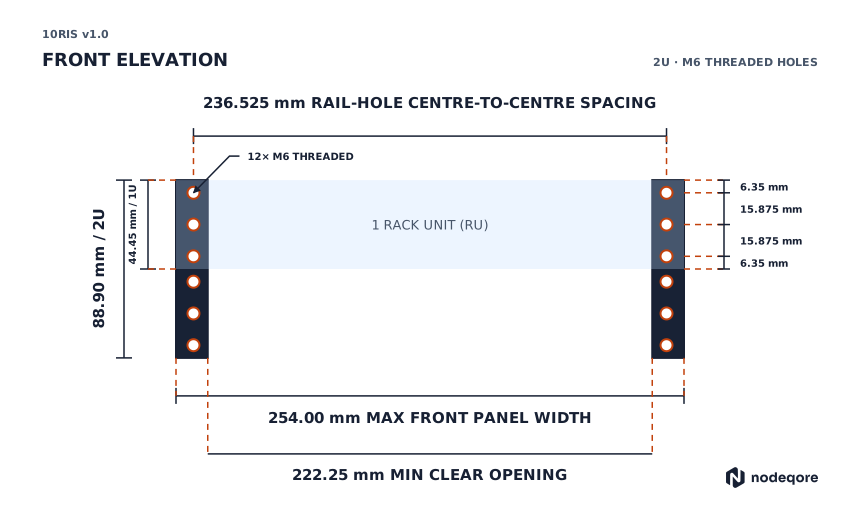
The full 10-inch rack interface specification contains the normative wording, reference SVGs, self-declaration requirements, and depth guidance. The 10RIS Rack Reference Generator produces a non-normative front-elevation reference for a selected mounting-hole type and rack height.
The Boundary of Version 1.0
Nodeqore does not claim to represent the whole rack industry or to grant compatibility approval. We publish measurable mounting data and accept correction in public. 10RIS is versioned, openly licensed, and based on self-declaration rather than a badge.
The proposal only covers a shared front interface. This lets equipment makers, accessory designers, and enclosure makers check fit against the same reference without making unsupported claims about an entire cabinet.
The Limits of Version 1.0
- The front mounting plane and vertical mounting-hole spacing are normative. A compatible accessory must fit the rail interface.
- Depth is guidance, not a compatibility requirement. A shallow desktop cabinet and a deeper four-post enclosure can expose the same front interface.
- Load rating, wall anchors, airflow, grounding, doors, and cable management remain product-specific engineering responsibilities.
- Rail reliefs and rail construction are not universal requirements.
This boundary allows manufacturers to publish comparable front-mounting geometry without implying a universal cabinet, load rating, or safety approval.
From Shared Measurements to Better Builds
For a single build, 10RIS should let a buyer compare a panel, PDU, shelf, and rack before ordering. A clear drawing and a declared profile cannot guarantee a complete installation, but they can remove avoidable uncertainty from the front mounting plane.
Across the ecosystem, the goal is a shared vocabulary. Product pages and drawings can state a version, mounting-hole type, maximum front-panel width, rail mounting-hole centre-to-centre spacing, clear opening, usable rack units, and tested configuration. That makes compatibility claims easier to compare, challenge, and improve without placing control of the format in one manufacturer.
The proposal is useful when future products state exactly what they implement and builders can make an informed decision when an interface does not match.
Work Still Outside the Interface
Depth, rail-adjustment range, rear cable clearance, loading, wall anchoring, airflow, grounding, doors, and electrical safety all matter to a real installation. They are not core requirements in version 1.0 because they depend on construction, material, installation method, and the equipment placed in the rack. Declaring them as universal limits now would create a false promise of interchangeability or safety.
We intend to keep learning from production hardware, customer feedback, and public builder research before proposing requirements in those areas. Builders, equipment makers, and rack manufacturers can submit a measured interoperability problem or a change proposal through 10RIS's public GitHub Issues. Future changes should be based on reproducible measurements and, where installation conditions are relevant, supported by real installation evidence.
An Open Claim, Not a Badge
10RIS v1.0 is published under CC BY 4.0. Its text and reference SVG drawings may be reused with attribution; Nodeqore names and trademarks remain separate. The specification has no Nodeqore approval badge or certification programme.
A self-declared compatibility statement must identify the specification version, supported mounting-hole type, measured maximum front-panel width, clear opening, measured rail mounting-hole centre-to-centre spacing, usable rack units, and tested configuration. This gives customers and manufacturers the measurements needed to review a compatibility claim.
The document provides a stable citation block, a versioned URL, and a public GitHub Issues path for errata and change proposals.
Explore 10RIS in Detail
10RIS v1.0 is designed to be read alongside product drawings and hardware. The specification is the source for its measurements and compatibility statements, and records the version a manufacturer used when making a claim.
10RIS v1.0 Specification
Explore the normative mounting dimensions, supported mounting-hole types, reference SVGs, and self-declaration requirements.
For a visual comparison of a mounting-hole type and rack height, the 10RIS Rack Reference Generator creates a non-normative front-elevation planning aid. The specification remains the source for conformance assessment.

